Iran war ends China’s deflationary spiral – but not in a good way
The Iran war has brought China's deflationary spiral to a sudden end.
Per price data released by the stats bureau (NBS) on April 10:
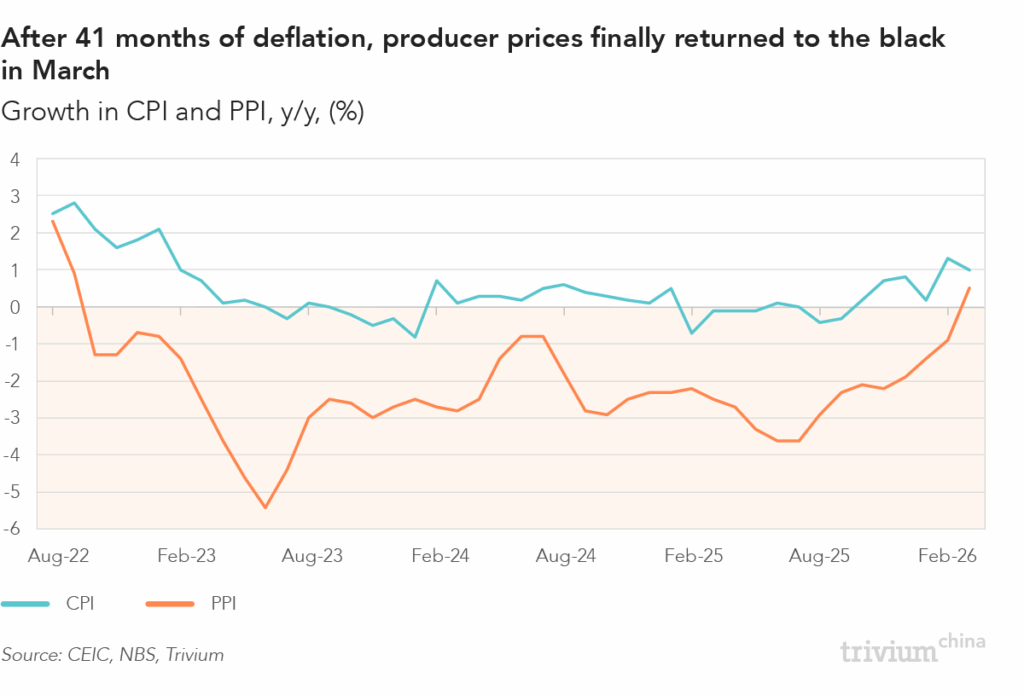
- Producer prices (PPI) grew 0.5% y/y in March – the first year-on-year increase in over three years
- China's purchasing price index – which measures manufacturers' input costs – rose 0.8% y/y, also the first increase since 2023.
ICYDK: In recent months, China's deflationary dynamics were already beginning to bottom out – the Iran war's energy price spike has simply brought that process forward by several months.
- On a month-on-month basis, PPI for the oil and gas extraction subsector surged 15.8%
The energy shock is feeding through to fuel prices at the pump.
- Consumer transportation fuel costs rose 10.0% month-on-month throughout March.
However, overall consumer prices (CPI) remain subdued:
- CPI grew 1.0% y/y in March, a slowdown from 1.3% growth the previous month.
- On a month-on-month basis, CPI fell 0.7%, driven by a post-Chinese New Year decline in food prices (-2.7%) and services (-1.1%).
Get smart: Ongoing uncertainty around the US-Iran ceasefire – combined with infrastructure damage to Gulf energy facilities – means elevated energy and input prices are unlikely to ease soon.
- Consequently, PPI growth is set to accelerate in the coming months and will eventually spill over into broader consumer prices.
Get smarter: Some analysts have cheered the long-awaited ending of China’s deflationary cycle – but this is the wrong kind of inflation.
- Cost-push inflation – as opposed to inflation driven by an increase in demand – compresses corporate margins rather than expanding them, and squeezes household disposable income without improving consumer confidence or the propensity to spend.