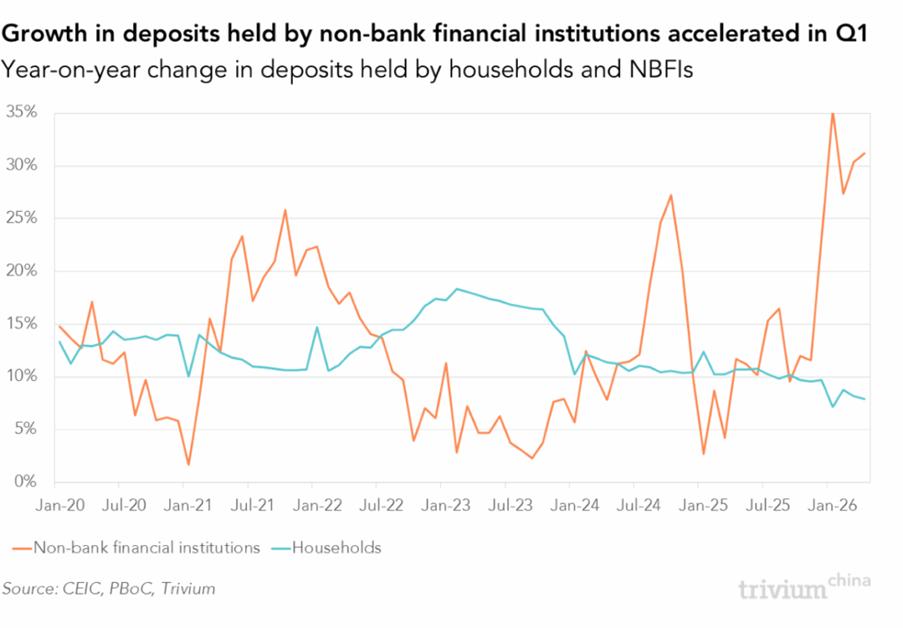
Households move savings away from banks
Households are migrating savings from banks to other financial institutions.
In April, deposits held by non-bank financial institutions (NBFIs) – such as insurers, wealth management products, funds, and securities brokerages – increased by RMB 2.47 trillion, the second biggest monthly increase after February 2025, when they rose RMB 2.83 trillion.
- NBFI deposits increased only RMB 1.57 trillion in April 2025.
Meanwhile, household deposits declined RMB 1.9 trillion in April, the largest drop on record.
ICYDK: Household deposits typically fall in April, as March tends to see an artificial spike driven by banks chasing end-of-quarter targets.
- Still, the depth of this year's decline is striking. April 2025 saw a decline of only RMB 1.4 trillion.
Some context: The pandemic drove a surge in long-term fixed-term deposits, a large volume of which are maturing this year. However, interest rates have plunged since the pandemic.
- Back then, 5-year deposits were earning up to 5% annual returns, whereas today they yield less than 2%.
In January, the PBoC said it expects some of the maturing deposits to be reinvested elsewhere.
Get smart: With fixed-term deposits no longer offering attractive rates, bond yields near record lows, and property prices still falling, households have few places to park their savings.
What we're pondering: Is a chunk going into stocks, either directly or via insurers, wealth management products, and funds?
- Certainly, April was a good month for the CSI 300, which rose 8% – an encouraging sign.
Our take: We don't know for sure, but we're on the look out for signs households are starting to embrace stocks.